
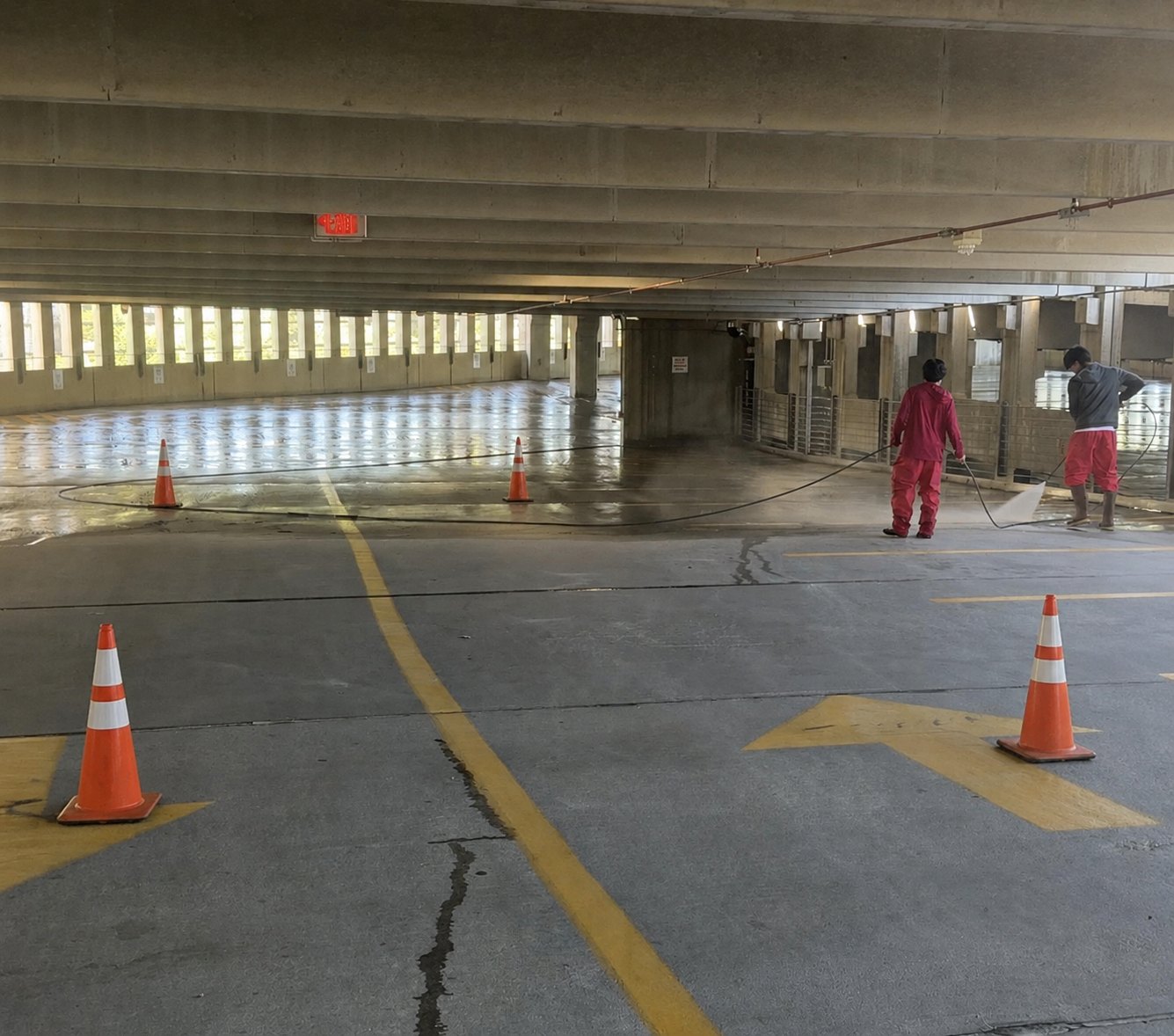
Top of the Line Services has provided commercial pressure washing and exterior building maintenance throughout Northern Virginia, Washington DC and Maryland since 2004.
Quick answer: Most commercial parking garages are professionally pressure washed one to four times a year, and a common baseline schedule is once or twice annually with additional targeted cleaning at entrances, ramps and stair cores. The right number for any specific property depends on traffic volume, whether levels are covered or exposed, how much oil and deicing residue accumulates, how well the deck drains, and the appearance standards the property is held to. These are planning starting points drawn from operating experience — not code requirements, and not a schedule that fits every garage.
Why Regular Parking Garage Cleaning Matters
A parking structure absorbs more concentrated abuse than almost any other surface on a commercial property. Every vehicle that enters brings tire residue, road film, brake dust, dripped fluids and, for several months of the year, whatever was spread on the roads to melt ice. Unlike a sidewalk or plaza, much of that load lands on surfaces that never see rain.
Appearance and tenant perception
For many buildings the garage is the first thing a tenant, patient, resident or visitor sees — before the lobby, before the signage, before anyone greets them. A deck with dark traffic lanes, stained stalls and gritty corners sets an expectation about how the rest of the building is run. Property managers raise this with us more often than any technical concern.
Surface conditions and traction
Accumulated oil film, tire rubber and fine grit change how a concrete surface behaves underfoot, particularly on ramps and in turning areas where vehicles scrub. Cleaning removes that accumulated residue. It does not, by itself, make a garage safe — traction, lighting, signage, slope and drainage are separate design and maintenance matters that belong to the property’s engineers and facility team.
Drainage and debris
Leaves, sand, gravel, trash and general grit migrate toward drains and low points. Removing that material during a scheduled cleaning keeps drainage paths clearer and gives maintenance staff a chance to see conditions that debris was hiding.
Deicing salts, chlorides and concrete
Deicing salts introduce chlorides. NIST identifies corrosion of steel reinforcement as the most prevalent deterioration mechanism in reinforced-concrete structures, with chloride ingress among the recognized mechanisms. That does not mean pressure washing prevents structural deterioration. Washing may remove surface contamination, but it does not inspect, repair or prevent structural deterioration — structural condition and corrosion risk must be evaluated by qualified engineering professionals.
Put plainly: washing a garage is housekeeping, not structural maintenance. It is not a substitute for inspection, repair or engineering evaluation, and it should never be scheduled in place of them.
What Determines How Often a Parking Garage Needs Cleaning
Vehicle and pedestrian traffic volume
Turnover matters more than capacity. A 400-space garage serving all-day employee parking accumulates residue differently from a 400-space garage serving a medical building where cars come and go all day. Higher turnover concentrates tire scrub in entrances, ramps and turning bays.
Covered levels versus exposed decks
These are different environments and often deserve different schedules rather than a single building-wide number.
Covered levels receive no rainfall at all. Oil film, tracked-in grime, tire residue and dust simply build up until something removes them, and poor air movement can let that film sit and darken.
Exposed decks face precipitation, pollen, organic debris from nearby trees, ultraviolet exposure and the full range of seasonal weather. Rain moves some material but also carries it into drains, and organic staining, pollen deposits and weathering are conditions covered levels rarely deal with.
Neither zone is universally dirtier — they are dirty in different ways, on different timelines. The practical approach is to look at each level and set its own interval.
Oil, grease, tire marks, gum and debris
Drip patterns in individual stalls, black scrub marks in turning areas, gum in pedestrian paths and general grit each respond differently to cleaning. Hot-water surface cleaning and appropriate pre-treatment substantially improve the appearance of most of these. Long-standing oil that has worked into porous concrete may leave a visible shadow after cleaning — we tell clients that up front rather than promising a stain will disappear completely.
Winter salt and deicing chemicals
Where deicing materials are applied, residue is tracked into the structure on tires and undercarriages and deposited across drive lanes and stalls. The number of applications varies considerably from winter to winter in this region, so the amount of residue a garage carries at the end of a season is not predictable from the calendar alone.
Ventilation and moisture
Enclosed lower levels with limited air movement stay damp longer. Slow drying supports biological growth in corners and along walls and can make grime harder to remove later. Garages with persistent damp areas generally need more attention than the level count alone suggests.
Drainage conditions
How water moves off a deck shapes both the cleaning plan and the schedule. Standing water after rain is worth investigating — it may point to a drainage design issue, insufficient slope, a partial blockage, settlement, or a maintenance item that has been deferred. Cleaning crews frequently spot these conditions, but diagnosing and correcting them is the property’s structural and plumbing responsibility, not the cleaner’s.
Property type and appearance standards
A Class A office tower, a hospital, a courthouse and a suburban condominium garage are judged against different expectations. Lease commitments, accreditation reviews, facility inspections and reserve-study planning all influence how often cleaning is budgeted.
Appearance standards rarely apply to one surface in isolation — the same properties that set expectations for the garage usually have a schedule for the building envelope too, which we cover in our guide to how often commercial building windows should be cleaned.
Construction activity and nearby road exposure
Active construction on or near the property drives dust, mud and tracked material into the structure at rates that have nothing to do with normal use. Garages fronting heavily travelled roads pick up more road film. Both can justify additional cleanings for a defined period, then a return to the normal schedule.
Common Starting Points for Maintenance Planning
| Property type or zone | Common starting point | Conditions that commonly shift it |
|---|---|---|
| Class A office buildings | Once or twice a year | Tenant standards, proportion of covered levels, event traffic |
| Hospitals and medical facilities | Two to four times a year | 24-hour turnover, patient and visitor traffic, and limited closure windows |
| Government and institutional facilities | Once or twice a year | Contract terms, security scheduling windows, inspection cycles |
| Retail and mixed-use properties | Two to three times a year | Seasonal peaks, food-service spills, gum, pedestrian volume |
| HOAs, condominiums and multifamily | Once a year, sometimes twice | Reserve-study planning, resident expectations, assigned parking |
| High-traffic or 24-hour facilities | Two to four times a year | Continuous turnover, limited closure windows |
| Exposed top decks | Often scheduled on their own cycle | Precipitation, pollen, organic debris, UV, winter conditions |
| Entrances, ramps, turning areas, stair cores, elevator lobbies | Targeted cleaning between full cleanings | Concentrated tire scrub and foot traffic |
These ranges are general planning guidance, not code requirements or universal schedules. The appropriate frequency depends on traffic, exposure, contamination, drainage, operating requirements and the property’s maintenance goals.
Signs a Parking Garage Needs Cleaning Sooner
Rather than waiting for the next scheduled date, watch for conditions that indicate the interval is not keeping up: drive lanes have darkened noticeably relative to the stalls; stalls show distinct drip patterns; a white or grey haze remains on the deck after deicing season; debris is collecting at drains and low points; enclosed corners look or smell damp; stair cores and elevator lobbies show tracked-in grime; and tenants, residents or staff have started mentioning it, which usually means the condition has been visible for a while.
None of these is an emergency. Together they indicate the schedule needs revisiting.
Seasonal Considerations in Northern Virginia, Washington, DC, and Maryland
Deicing applications in the region cluster in the colder months, but the number of events and the amount of material used vary substantially year to year. Some winters leave a garage with heavy residue; others leave very little. That variability is why we suggest evaluating the deck after the deicing season ends rather than committing to a fixed date.
For many properties in the region, a cleaning scheduled after deicing season often produces a noticeable change, because it addresses residue that has been accumulating for months without rainfall reaching the covered levels. Whether it is the right single cleaning for a specific garage still depends on that garage.
Other seasonal factors worth planning around: pollen loads in spring affect exposed decks and can be heavy in this region; summer heat speeds drying and makes overnight work more comfortable but can also cause cleaning solutions to dry too quickly on hot surfaces; autumn brings organic debris onto top decks from surrounding trees, particularly near drains; and freezing conditions constrain wet work, which is a scheduling reality rather than a strict prohibition.
What Professional Parking Garage Pressure Washing Generally Involves
Site walk and scope
A walkthrough establishes level count, square footage, surface condition, drain locations and destinations, water and power access, ceiling heights, traffic patterns, and the closure windows the property can actually accommodate.
Debris removal
Loose material is removed before any water is introduced. Washing debris toward drains creates blockages and moves material the property did not intend to discharge.
Pre-treatment
Concentrated oil, grease and stained areas are treated ahead of the general wash so the cleaning step is not doing all the work at once.
Surface cleaning and rinsing
Rotary surface cleaners handle open deck area consistently; wands and detail work handle edges, curbs, stalls, stair cores and corners — the same equipment range we use across commercial pressure washing projects. Equipment and pressure are selected for the surface, since concrete decks, coated decks and sealed surfaces are not treated identically.
Water handling
Wash water is managed according to the plan established for the site before work begins. This is covered in the next section.
Reopening
Cleaned areas are cleared of standing water to the extent practical, signage stays up while surfaces dry, and areas are returned to service in a sequence agreed with the property.
Wash Water, Environmental Requirements and Site Safety
Where the water goes
Wash water should never be assumed acceptable for discharge into a storm drain. The Clean Water Act and NPDES program regulate certain discharges, while state environmental agencies, local stormwater authorities, sewer utilities and facility-specific permits may impose additional requirements. The acceptable handling method depends on the contaminants, discharge destination, jurisdiction and property.
Five distinct things get confused in practice and are worth separating. Storm drains typically discharge to surface waters with no treatment. Sanitary sewer connections route to treatment, but discharging into them normally requires authorization from the sewer utility and may carry conditions. Containment and recovery means blocking or berming drains, collecting the water and hauling it to an approved disposal point. Facility-specific permits matter because a property may hold its own stormwater or industrial permit with terms that govern this work directly. Local authorization matters because the county, city or municipal stormwater authority may have requirements that differ from both state and federal rules.
Determining which applies is a property-specific question. In the service area, the relevant agencies are the Virginia Department of Environmental Quality, the DC Department of Energy and Environment, and the Maryland Department of the Environment. We plan water handling with the property before work begins, but we are a cleaning contractor — we do not give legal advice, and properties with permit obligations should confirm requirements with their environmental counsel or the relevant authority.
Safety during wet work
For employers whose workers may enter the affected area, OSHA 29 CFR 1910.22 addresses clean, orderly and sanitary walking-working surfaces, recognized hazards, floor conditions and drainage during wet processes. Site-specific controls and reopening procedures should be planned accordingly.
Top of the Line carries certificates of insurance, maintains training records, and prepares site-specific work plans for commercial projects. Details are on our Safety & Compliance page.
How Facilities Reduce Disruption
Phased closures
Most occupied garages cannot close entirely. Work is broken into sections — a level, a bay, a ramp — cleaned, dried and reopened before the next section begins.
Low-traffic and overnight scheduling
Office garages are often cleaned on weekends or overnight. Hospitals may have few quiet periods, so work can follow the smallest available windows across more nights. Retail can be scheduled around trading hours and seasonal peaks.
Signage and traffic control
Barricades, cones, wet-floor signage and directed pedestrian routes are set before water is introduced and stay until surfaces are ready. Advance notice to tenants and residents prevents most complaints.
Coordination with property management
Access, keys and fobs, elevator and stair closures, security notification, water and power sources, and the reopening sequence are confirmed before mobilisation. On government and healthcare sites this coordination can take longer to arrange than the cleaning takes to perform.
What Affects the Cost of Parking Garage Pressure Washing
Pricing varies too much between properties for a published figure to be useful, so here is what actually moves it. Total square footage and level count set the baseline. Surface condition matters, since a garage cleaned annually generally costs less per visit than one that has gone years without. Access constraints such as low clearances, tight ramps and limited water or power access slow production. Water handling requirements are among the largest variables, because containment, recovery and hauling cost considerably more than a site where an approved discharge point is available. Scheduling constraints also raise cost, since restricted or overnight scheduling, phased closures and heavy traffic-control requirements all extend the number of shifts required. Detail work at stair cores, elevator lobbies, curbs, walls, ceilings and stall-by-stall stain treatment is priced separately from open deck area. Frequency and contract structure matter too, as properties on a recurring schedule generally see better per-visit pricing because the deck is in better condition and mobilisation is planned.
The only reliable way to get a real number is a site walk. We provide written estimates after seeing the structure, and our parking garage pressure washing service page explains what a commercial project includes.
Frequently Asked Questions
How often should a parking garage be pressure washed?
Most commercial garages fall in the one-to-four-times-a-year range, with once or twice a year serving as a common baseline. Traffic, exposure, contamination, drainage and appearance standards move it within that range, and different levels of the same structure often warrant different intervals.
Can pressure washing remove oil stains completely?
Appearance improves substantially in most cases, especially with appropriate pre-treatment and hot water. Oil that has worked into porous concrete over a long period can leave a visible shadow after cleaning. We would rather set that expectation before the work than after.
Does cleaning make a parking garage safe?
No. Cleaning removes accumulated residue and debris and makes conditions easier to observe. Safety depends on structural condition, lighting, signage, slope, drainage and traffic design — all matters for the property’s engineers and facility team. Cleaning is not a substitute for inspection, repair or engineering evaluation.
Does the garage have to close?
Rarely in full. Work is normally phased section by section so most of the structure stays available, with scheduling built around the property’s quietest hours.
Where does the wash water go?
That depends on the contaminants, the discharge destination, the jurisdiction and the property. Options include an authorized sanitary sewer connection, or containment and recovery with hauling to an approved disposal point. It is planned for each site before work starts, and properties that hold their own environmental permits should confirm the terms with the issuing authority.
Is winter a bad time to clean a parking garage?
Freezing conditions constrain wet work, so cleaning is usually planned around them. Many properties in this region evaluate the deck once the deicing season has ended, since that is when accumulated residue is at its most visible on covered levels.
Do covered levels and open top decks need the same schedule?
Often not. Covered levels accumulate oil, tracked-in grime and tire residue with no rainfall reaching them. Exposed decks deal with precipitation, pollen, organic debris, UV and seasonal weather. Entrances, ramps, turning areas, stair cores and elevator lobbies frequently need targeted attention between full cleanings. Setting an interval per zone is usually more practical than one building-wide number.
How long does a cleaning take?
It depends on square footage, level count, surface condition, access and how narrow the closure windows are. A phased job on an occupied 24-hour facility can span several nights where an open weekend on a smaller structure would not.
What affects the cost?
Square footage and level count, surface condition, access constraints, water-handling requirements, scheduling restrictions, the amount of detail work, and whether the property is on a recurring schedule. Water handling and restricted scheduling are among the largest variables.
Plan Your Parking Garage Cleaning Schedule
There is no single correct frequency for every parking structure. The right schedule comes from looking at a specific garage — its traffic, its covered and exposed levels, its drainage, its winter exposure and the standards it is held to — and building a plan around it.
Top of the Line Services has cleaned commercial, institutional, government, healthcare and multilevel parking facilities across Northern Virginia, Washington, DC, and Maryland since 2004. If you are budgeting for the year or reviewing whether your current interval is keeping up, we can walk the structure, identify the zones that need different treatment, and give you a written estimate.